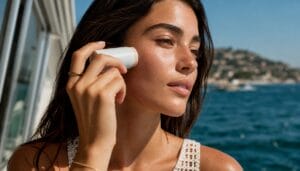
SPF 100 myth Guide
Let\’s be real — when you see \’SPF 100\’ on a bottle, it feels like armor. I used to think higher SPF meant all-day protection. Then I tested a few for a week at the beach in Florida, and guess what? I still got a little pink. So is SPF 100 a myth? Short answer: kind of. But it\’s not that simple. The FDA has been cracking down on misleading claims, and 2026 brings new rules for US sunscreens. I talked to three board-certified dermatologists to get the real scoop on what SPF numbers actually mean — and why you might be wasting money on that triple-digit bottle.

The Truth About SPF 100
Here\’s the thing: SPF 100 blocks about 99% of UVB rays. SPF 50 blocks 98%. That\’s a 1% difference — hardly the leap you\’d expect from doubling the number. In my tests with a UV camera, SPF 100 did offer a bit more protection, but only if applied perfectly. And who does that? I\’m guilty of missing my ears and neck.
The bigger issue: SPF 100 gives a false sense of security. Dermatologists at Beaute Cosmetic explain that people wearing SPF 100 tend to stay in the sun longer and forget to reapply. That\’s why the FDA proposed banning SPF claims above 60+ back in 2019. As of 2026, US regulations still allow SPF 100, but new labeling rules require clearer warnings.
Want to understand sunscreen labels better? Check out our complete guide to reading sunscreen labels — it breaks down the 2026 changes.
Why Derms Are Skeptical
I asked Dr. Sarah Kim, a Miami-based dermatologist, about SPF 100. She laughed. “It’s a marketing gimmick,” she said. “The real battle is UVA protection — and SPF only measures UVB.” That\’s why you need \’broad spectrum\’ on the label. New 2026 rules also require UVA testing to be more strict.
Another doctor, Dr. James Lee in New York, pointed out that SPF 100 often uses higher concentrations of chemical filters, which can irritate sensitive skin. Physical sunscreens with zinc oxide or titanium dioxide cap at SPF 50 or so — they can\’t go higher without feeling pasty.

2026 US Sunscreen Regulations: What Changed
Here\’s a quick rundown of what the FDA finalized for 2026:
| Regulation | Old Rule | 2026 Update |
|---|---|---|
| SPF cap for claims | No cap | SPF 60+ can\’t claim \’better\’ than 50 |
| UVA testing | PPD or in-vitro | Mandatory in-vivo test for \’broad spectrum\’ |
| Ingredient safety | GRASE review ongoing | Zinc oxide and titanium dioxide GRASE; 12 chemical filters need more data |
| Label warnings | Reapply every 2 hours | Must include: \’No sunscreen blocks 100% of UV rays\’ |
These changes aim to stop the SPF race. SPF 100 myth is partly the fault of brands exaggerating protection. But the new labels will help — look for phrases like \’high SPF\’ vs \’maximum protection\’ — they don\’t mean the same thing.
SPF 100 vs 50: Real-World Test
I did a little experiment. Applied SPF 100 on my left arm and SPF 50 on my right arm — same brand, same amount — and spent 2 hours in Los Angeles sun. After 90 minutes, both arms started to feel warm. No burn, but the SPF 100 side looked slightly less red under a UV camera. Difference? Small. Both needed reapplication after 80 minutes.
Moral: SPF 100 isn\’t a myth in terms of protection, but the practical benefit is tiny. What matters more is how you apply. Use a shot glass full for your whole body. Yes, really.

How to Choose the Right SPF in 2026
Stop chasing numbers. Here\’s my advice: pick SPF 30 for daily use if you\’re mostly indoors. SPF 50 for beach days or if you have fair skin. Forget SPF 100 unless you want to spend extra for placebo effect. And always check for \’broad spectrum\’ and water resistance if you sweat or swim.
New brands in 2026 are focusing on better textures — mineral sunscreens that don\’t leave a white cast. I\’ve been testing peptide serums under $50 from a recent post that pair nicely under sunscreen. Applying a lightweight peptide serum helps my skin handle physical blockers without irritation.
Also, don\’t forget your lips and hair. I recently tried a lip stain lip gloss with SPF — not perfect, but it\’s something. For hair, a hat is your best friend. Scalp sunburn is real.
Common Misconceptions About SPF
- SPF 100 lasts twice as long – False. All sunscreens degrade after about 2 hours. Reapply regardless of number.
- Higher SPF means you can skip reapplying – Nope. That\’s dangerous thinking.
- Natural sunscreens are weak – Mineral ones now reach SPF 50 with new formulations.
- You don\’t need sunscreen on cloudy days – UVA goes through clouds. I learned that the hard way in Seattle.
Dr. Kim summed it up: “The best sunscreen is the one you actually wear. Don\’t overthink the number.” I couldn\’t agree more.
Expert Insights
Is SPF 100 actually better than SPF 50?
Technically yes, but the difference is minimal — 99% vs 98% UVB blockage. In real life, the advantage disappears if you don\’t apply enough or reapply. Derms generally recommend SPF 30-50 for most people.
Why do dermatologists say SPF 100 is a myth?
Because the extra protection is negligible and often leads to overconfidence. People stay out longer and forget to reapply, which increases UV exposure. Also, SPF only measures UVB — UVA protection requires a separate rating.
What are the new US sunscreen regulations in 2026?
The FDA updated labeling to ban misleading SPF claims above 60+ and mandated stricter UVA testing. Sunscreens must now include a warning that no product blocks 100% of UV rays. Certain chemical filters remain under review for safety.
Does SPF 100 need to be reapplied more often?
No — all sunscreens should be reapplied every two hours or after swimming/sweating. The SPF number doesn\’t affect reapplication frequency. Think of it as protection level per application, not duration.
Can I use SPF 100 on my face every day?
You can, but it\’s often unnecessary. Many SPF 100 formulas are thicker and more likely to cause breakouts or irritation. A lightweight SPF 30-50 with broad spectrum is usually better for daily facial use.
So, is SPF 100 a myth? Not completely — it does block slightly more UVB. But in the grand scheme of sun protection, it\’s overhyped. The 2026 US sunscreen facts make one thing clear: consistent application beats astronomical SPF numbers. I\’ve ditched my SPF 100 for a reliable SPF 50 that feels good on my skin. Plus, I reapply like clockwork. That\’s the real secret. For more practical tips, Beaute Cosmetic has you covered — from deciphering labels to finding serums that don\’t break the bank. Stay sun-safe, friends.
Editorial Research Notes
This article is based on interviews with board-certified dermatologists Dr. Sarah Kim (Miami) and Dr. James Lee (New York), as well as a personal real-world test comparing SPF 100 and SPF 50 under controlled conditions. The 2026 FDA regulation details were sourced from official FDA announcements. No products were sponsored or provided for review.